

Why is my car overheating? In most cases, the engine is making more heat than the cooling system can carry away. Something in that system isn’t doing its job: the coolant, the water pump, the thermostat, a hose, or the radiator itself. A single serious overheating event can crack a cylinder head or warp the engine block. A rising temperature gauge is never something to shrug off. This guide covers the most common car overheating causes, exactly what to do the moment the needle starts climbing, why car overheating in traffic is so common in Houston, and how Duggy’s Garage fixes the problem for good.
Most of the time, a car overheats because coolant isn’t circulating and absorbing heat the way it should. That can mean a few things. The coolant level is low from a leak. The water pump has failed. The thermostat is stuck closed. Or the radiator and cooling fan can’t move enough air to bring the fluid temperature back down. If the gauge is climbing right now, pull over safely and shut the engine off. If it keeps happening, it’s time for a proper diagnosis at Duggy’s Garage.
Here is a quick rundown of what typically causes the problem:
The most frequent of all car overheating causes, usually from a cracked hose, radiator, or water pump seal.
Coolant stops circulating through the engine even if the reservoir is full.
The valve that controls coolant flow to the radiator gets stuck closed and traps heat in the engine.
Debris, a bent core, or a dead fan motor keeps heat from escaping.
A hose that bursts or collapses cuts off coolant flow almost instantly.
Worn-out coolant loses its ability to absorb and release heat efficiently.
Low airflow at low speeds makes an already-weak cooling system fall behind fast.
The louder or more sudden the temperature spike, and the more it is paired with steam, a warning light, or a sweet smell under the hood, the sooner the vehicle needs to be looked at.
This is the single most common answer to why is my car overheating. Coolant absorbs heat as it moves through the engine, and if the level drops too low, there is not enough fluid left to do the job. Leaks usually show up as a puddle under the front of the car, a sweet smell in the engine bay, or a coolant warning light on the dash.
The water pump is what actually pushes coolant through the engine and radiator. When the pump’s bearing or seal wears out, coolant stops moving even if the reservoir looks fine. A worn water pump often whines or squeals before it fails outright, giving drivers a short warning window to get it replaced.
The thermostat is a small valve that only opens once the engine reaches operating temperature, letting coolant flow into the radiator. If it sticks closed, coolant gets trapped in the engine and the temperature climbs fast, sometimes within a few minutes of driving.
The radiator needs steady airflow to pull heat out of the coolant. Road debris, bent fins, or a cooling fan that will not kick on can all choke off that airflow, especially at idle or in slow traffic when there is little natural airflow through the grille.
Radiator hoses carry coolant between the engine and the radiator under constant heat and pressure. Over time, rubber hoses can crack, blister, or collapse internally, cutting off flow even when the hose looks fine from the outside.
Coolant breaks down over time and loses the additives that protect against corrosion and help it transfer heat efficiently. Rust and scale can also build up inside an old cooling system, narrowing passages and reducing how well heat moves out of the engine.
This is less a single mechanical cause and more a stress test for an already-weak cooling system. Idling in traffic on a 95-degree Houston afternoon gives the radiator far less airflow than highway driving, so a marginal water pump, low coolant level, or aging fan clutch that seemed fine on the freeway can push the engine into the red the moment traffic slows down.
Knowing car overheating what to do in the moment can be the difference between a simple repair and a blown engine. Turn off the air conditioning and turn the heater on full blast. This pulls heat away from the engine and toward the cabin, buying a little time. If the gauge keeps climbing, pull over as soon as it is safe and shut the engine off completely. Do not open the radiator cap or coolant reservoir while the engine is hot, since pressurized coolant can cause serious burns. Let the vehicle sit for at least fifteen minutes before checking anything under the hood.
Once the engine has cooled, check the coolant reservoir level if it is safe to do so. If it is low and a top-off gets the gauge back to normal, it may be safe to drive a short distance to a shop. If the level keeps dropping, there is visible steam, or the temperature spikes again right away, the safer move is a tow rather than risking further damage. Keeping these car overheating what to do steps in order, AC off, heater on, pull over, let it cool, is the simplest way to protect the engine until a technician can take a proper look.
Car overheating in traffic comes down to airflow. At highway speeds, air moves through the grille and across the radiator constantly, doing a lot of the cooling work for free. In stop-and-go Houston traffic, that airflow disappears, so the cooling fan has to do all the work of pulling air through the radiator on its own.
If the fan, thermostat, water pump, or coolant level is already borderline, a slow commute or a long red light is often what pushes the temperature over the edge, even though the same vehicle runs cool on the open road. A cooling system that checks out fine on the highway can still need attention if it consistently runs hot in traffic.
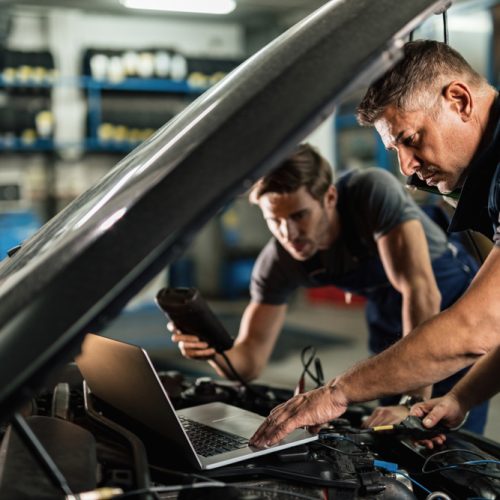
Every overheating vehicle that comes into the shop gets a full cooling system inspection from ASE Master Certified technicians, not a guess. The team pressure-tests the system for leaks, checks the water pump, thermostat, hoses, and radiator, and flushes old coolant when it has broken down. Duggy’s Garage also inspects belts and hoses during routine maintenance, catching a cracked hose or aging water pump before it strands a driver in Houston traffic.
If the temperature gauge has been climbing, or the car has already overheated once, visit the radiator and cooling system repair page to see the full range of services, or book an appointment with Duggy’s Garage in Houston for a full diagnosis before a small issue turns into an engine repair.
At low speeds, the radiator depends almost entirely on the cooling fan to pull air through it, since there is little natural airflow coming through the grille. If the fan motor, fan clutch, or fan relay is weak, the system can keep up fine on the highway but fall behind the moment traffic slows to a crawl. This pattern is one of the more common car overheating causes drivers notice in Houston. If the gauge climbs in traffic but drops back to normal once moving again, it is worth having the cooling fan and thermostat checked before the problem gets worse or starts happening on the highway too.
A brief flicker into the warm zone that settles back down is generally not an emergency, but it is still a signal that something in the cooling system is working harder than it should. Even a mild, repeated pattern of overheating can point to a leak or a failing part that will get worse over time.
A single severe overheating event, on the other hand, can cause lasting engine damage such as a cracked cylinder head or a blown head gasket. If the gauge ever reaches the red zone, warning lights come on, or steam appears, the safest choice is to pull over immediately rather than trying to finish the drive.
Start with the basics: the coolant reservoir level, any visible puddles or wet spots under the front of the car, and whether the cooling fan is actually spinning when the engine is hot. Many overheating issues trace back to something as simple as a low coolant level or a loose hose clamp.
If those basics look normal and the car is still running hot, especially in traffic, the issue is more likely a failing water pump, a stuck thermostat, or a radiator problem that needs a professional inspection. Continuing to drive on a guess risks turning an affordable repair into a full engine rebuild.
This almost always points to a cooling system that is just barely keeping up. Highway speeds push extra air through the radiator, masking a weak fan, a partially clogged radiator, or a coolant level that is a little low.
Once that extra airflow disappears in stop-and-go traffic, the system cannot keep pace with the heat the engine is producing. A cooling system inspection can usually pinpoint which specific component is the weak link before it leaves a driver stranded on a Houston freeway on-ramp.